
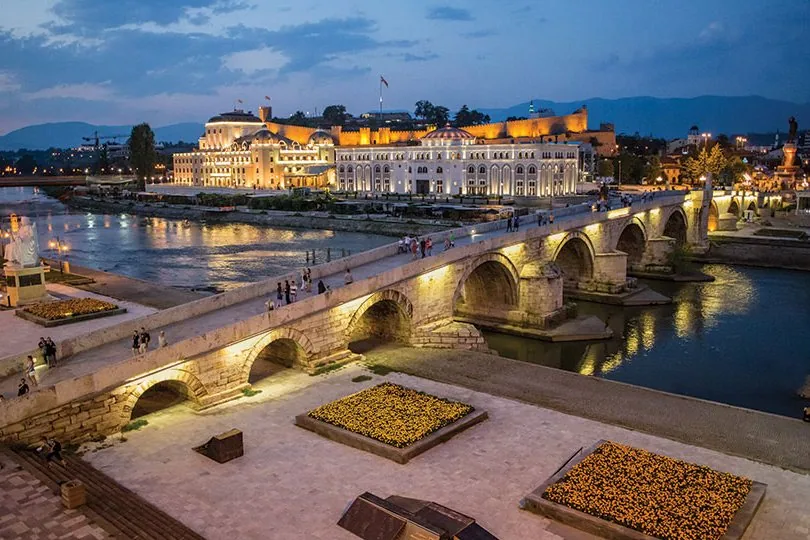
Skopje is often introduced through contrast.
The Stone Bridge connects two sides of the centre that look and feel different. The Old Bazaar sits close to newer buildings and large public squares. Ottoman structures, post-earthquake modernism, contemporary construction, neighbourhood cafés, markets, and mountain views all appear within the same city.
These contrasts are real, but Skopje is more than a collection of opposites. The city makes more sense when it is experienced as a sequence of layers.
You cross the Vardar. You move from a formal square into the narrow streets of the bazaar. You leave the centre for a neighbourhood where the pace changes. You look up and see Vodno above the buildings. You pass architecture created after the 1963 earthquake and realise that the city's present shape is connected to both loss and international solidarity.
Skopje is the capital, but it should not be used as a shortcut for understanding all of Macedonia. Ohrid, Bitola, Tetovo, Prilep, Strumica, Kumanovo, Krusevo, Stip, and other places have their own identities and rhythms. This story stays within Skopje and focuses on several places that reveal how the city works.
The Stone Bridge is a crossing between different worlds
The Stone Bridge is one of Skopje's most recognisable symbols, but its importance becomes clearer when we actually use it.
On one side are Macedonia Square, the pedestrian streets, and the newer centre. On the other side begins the route toward the Old Bazaar, Kale, mosques, churches, inns, workshops, shops, and Bit Pazar.
The bridge is now reserved for pedestrians. This slows the crossing and gives people time to notice how quickly the city changes around them. Street musicians, people meeting friends, tourists, workers, and families all use the same narrow route across the Vardar.
For people from Skopje, the bridge is not only a monument. It is a practical connection between parts of the city that carry different histories and communities.
The most useful way to experience it is not to stop only for a photograph. Cross it in both directions. Look toward Kale, then back toward the square. The bridge becomes more meaningful when the two sides are seen together.
The Old Bazaar should be explored slowly
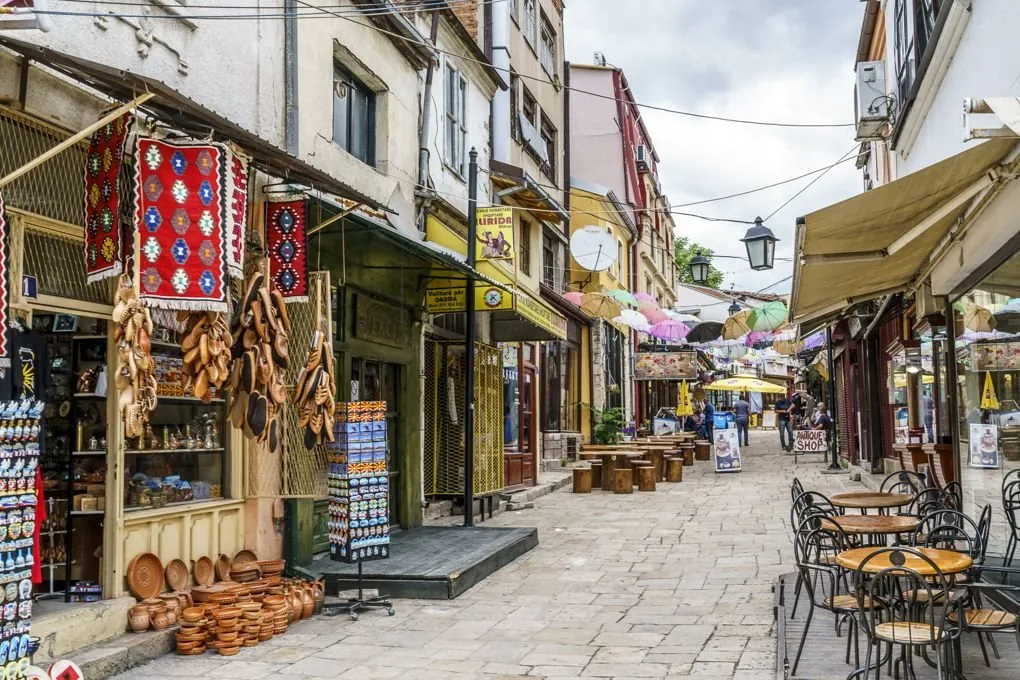
The Old Skopje Bazaar stretches from the Stone Bridge toward Bit Pazar, with Kale rising above it.
It contains shops, workshops, cafés, tea houses, mosques, churches, inns, museums, and streets whose function changes from one corner to the next. Some sections feel busy and commercial. Others become quiet within a few steps.
The bazaar is protected as cultural heritage of special importance. That status reflects its historical value, but the area is not frozen in the past. People still work there, meet there, shop there, repair things, drink tea, eat, and move between the bazaar and nearby neighbourhoods.
A quick walk through the main street shows only part of it. The area becomes more interesting when you turn into smaller passages, enter an old inn, look for workshops, or sit down without treating the stop as a task.
The Museum of the Old Skopje Bazaar in Suli An offers historical context. The nearby Mustafa Pasha Mosque, the Church of the Holy Saviour, Kurshumli An, and the route toward Kale each reveal a different part of the area's history.
The bazaar is also one of the places where Skopje's multicultural character is most visible. Different religious, linguistic, culinary, and commercial traditions meet within a relatively small space.
Debar Maalo and the City Park belong to the living city
Visitors often remain between the square and the bazaar. Skopje's everyday social life becomes clearer when we move west toward Debar Maalo and the City Park.
Debar Maalo is known for restaurants, cafés, older residential streets, newer buildings, and an evening atmosphere that can change from relaxed to crowded within a short distance. It is not one uniform neighbourhood. Some streets are loud and social, while others remain residential.
The nearby City Park gives the area a different rhythm. People walk, exercise, meet friends, bring children, sit near the paths, or continue toward the stadium and the Vardar riverbank. In warmer months, the park becomes one of the easiest places to spend time without needing a detailed plan.
For many people who grew up in Skopje, this combination is familiar. A meeting may begin with coffee in Debar Maalo, continue with a walk through the park, and end somewhere entirely different.
This is the Skopje that does not always appear in historic descriptions. It is social, improvised, and shaped by repeated habits.
The earthquake is still present in the city's architecture
On 26 July 1963, at 5:17 in the morning, a devastating earthquake struck Skopje.
The disaster killed more than one thousand people and destroyed large parts of the city. The reconstruction that followed brought international assistance, new urban plans, and major modernist buildings. This period still shapes how Skopje looks and how its residents understand the city.
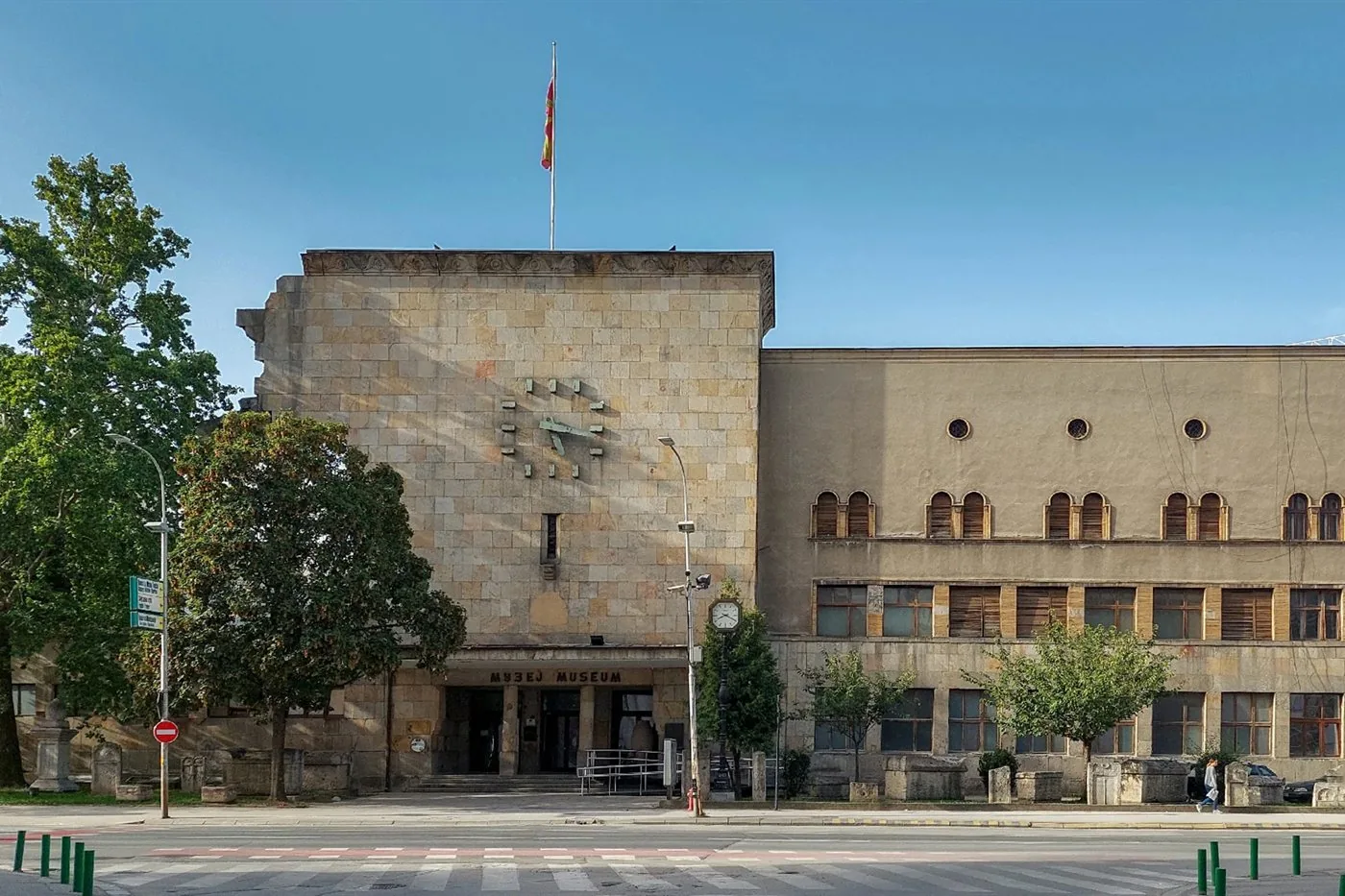
The old railway station, partly preserved after the earthquake, now houses the Museum of the City of Skopje. It remains one of the clearest places to connect the present city with the events of 1963.
The Museum of Contemporary Art tells another part of the story. It was established in 1964 after artists and institutions from around the world donated works in solidarity with Skopje. Its building, opened in 1970, was based on a project donated by the Polish government.
This history explains why parts of Skopje contain architecture that feels different from the bazaar or older neighbourhoods. Concrete structures, large civic buildings, residential blocks, and modernist planning are not random additions. They belong to a city that had to rebuild quickly and became an international project.
To understand Skopje, it is worth looking beyond whether someone finds a building beautiful. The more important question is what problem it was trying to solve and what moment in the city's history produced it.
Vodno is always part of the view
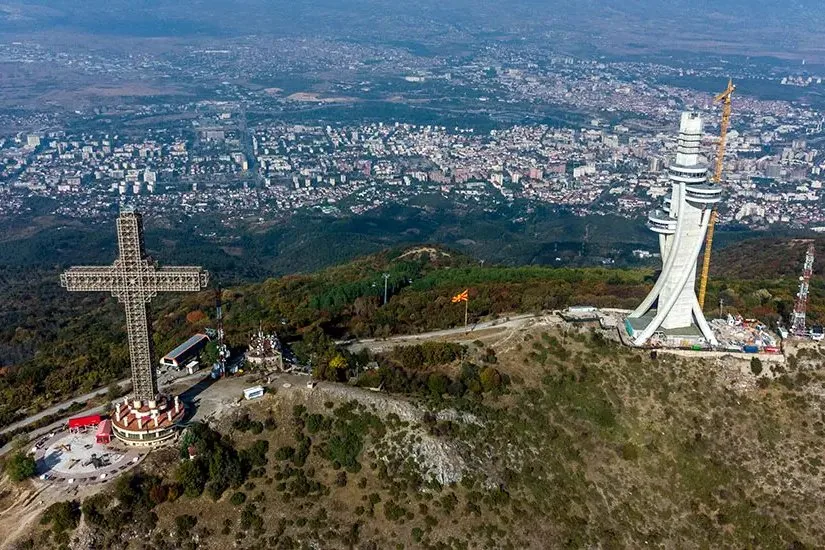
Vodno is one of the few elements that remains visible across very different parts of Skopje.
The mountain rises south of the city and often works as a point of orientation. From streets, balconies, bridges, and neighbourhoods, looking toward Vodno helps people understand where they are.
For residents, Vodno is not only a distant backdrop. It is a regular place for walking, cycling, exercise, family outings, and a quick escape from traffic. The routes and level of effort vary, which allows different people to create their own relationship with the mountain.
Further from the centre, Matka Canyon offers another kind of landscape, with steep rock, water, paths, monasteries, and caves. It feels separate from the city even though it is closely connected to Skopje's wider area.
Vodno and Matka help explain an important part of local life. Skopje can feel intense, crowded, and noisy, but the possibility of leaving that energy for a mountain or canyon remains close.
The contrast is not abstract. It can happen within the same day.
Skopje is not one single image
Skopje is easy to misunderstand when reduced to one square, one architectural period, or one political opinion.
The city is the Stone Bridge and the streets beyond it. It is the Old Bazaar in the morning and Debar Maalo in the evening. It is the memory of 1963, the modernist city that followed, the neighbourhoods that expanded later, and the public spaces people continue to reshape through daily use.
It is also a city of several languages and communities. That diversity is visible in neighbourhoods, markets, places of worship, family histories, food, and the way different people describe the same street.
Our advice is to avoid trying to decide too quickly what Skopje is.
Cross the bridge. Walk past the main bazaar street. Visit the old railway station. Look at the city from the Museum of Contemporary Art or from Kale. Spend time in a neighbourhood that is not built around monuments. Then look toward Vodno.
Skopje does not become simpler after this. It becomes more understandable.
That is the point. Its character is not found in one perfect view, but in the way many different layers continue to exist beside one another.