
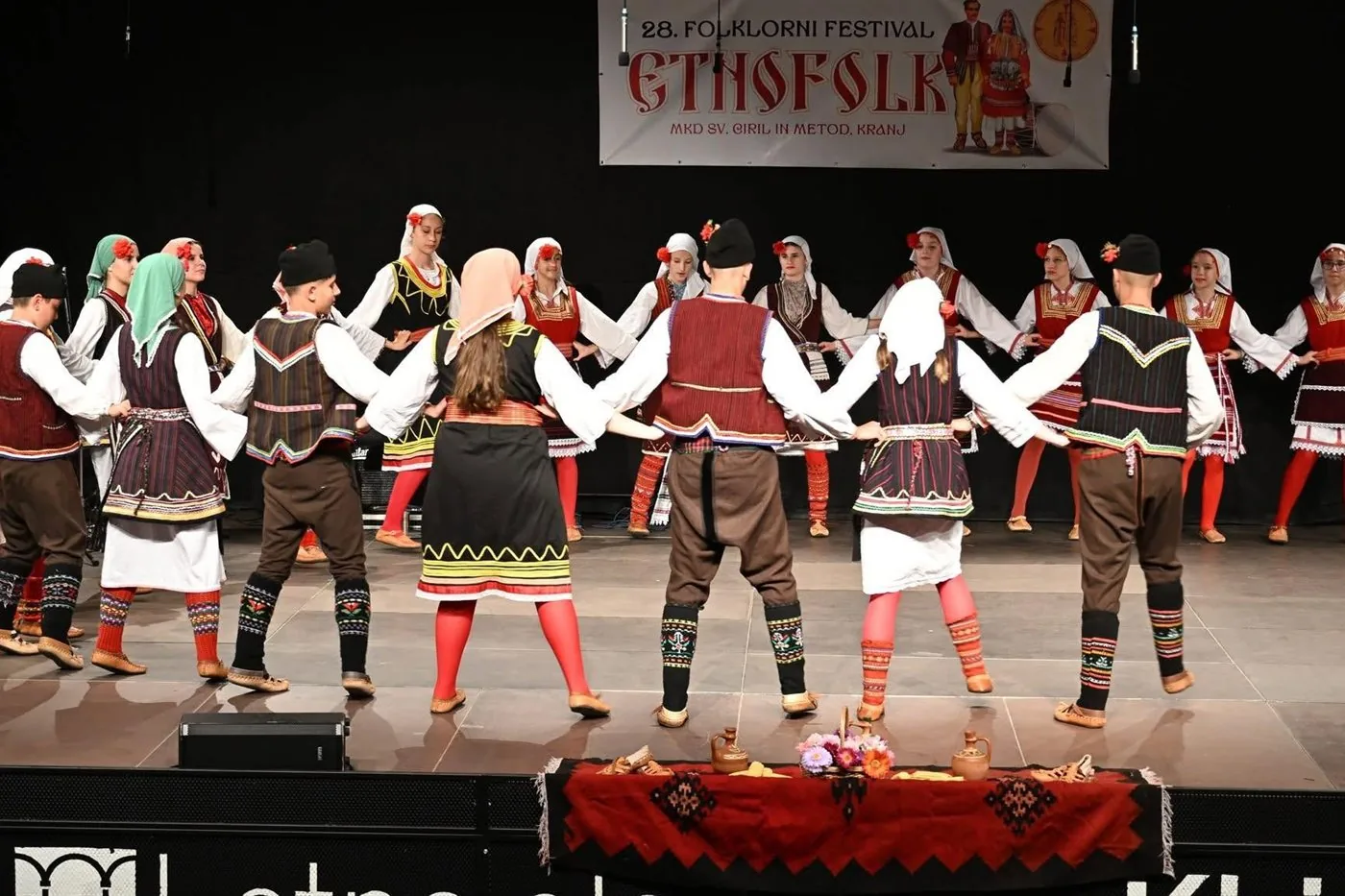
A Macedonian celebration can change in a few seconds.
People may be seated, talking in smaller groups, when a familiar rhythm begins. Someone recognises the song. Another person stands. Hands connect, the line grows, and the room reorganises itself around an oro.
Not every gathering follows the same pattern. Macedonia has different regions, communities, musical traditions, generations, and tastes. A village wedding, an urban club, a family celebration, and a cultural festival sound very different.
The common idea is participation.
Music is often strongest when the border between performer and audience becomes unclear.
Oro is a social form, not one single dance
“Oro” is a general term used for a wide family of traditional dances.
Dancers commonly form a line, semicircle, or circle and connect by holding hands, shoulders, or belts, depending on the dance. Steps can be slow and controlled or fast and energetic. Rhythms and movement patterns vary by region.
The first and last positions in the line can carry particular responsibility. An experienced leader guides direction, tempo, and changes in movement.
For someone joining for the first time, the practical rule is to watch before stepping in. Begin near people who know the dance. Follow the feet and do not pull the line in a different direction.
The purpose is not individual performance.
Even when one dancer shows greater skill, the form depends on connection. The dance works only when people adjust to one another.
Tapan and zurla can change the atmosphere instantly
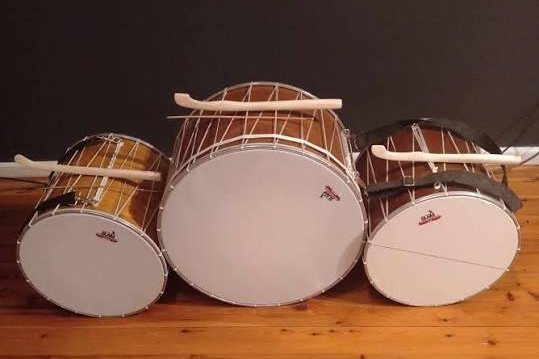
The tapan is a large double-headed drum played with two different sticks. It creates both a deep pulse and sharper rhythmic accents.
The zurla is a loud wind instrument with a penetrating sound that carries easily in open spaces.
Together, tapan and zurla are closely associated with outdoor celebrations, weddings, village gatherings, and traditional dance. Their sound is physical. It does not stay in the background.
Other instruments also shape Macedonian musical traditions, including the kaval, gajda, tambura, and various string and percussion instruments.
The exact combination depends on the region and musical form.
For many people living abroad, these sounds have an immediate emotional effect. A few notes can bring back a wedding, a village celebration, a family story, or a place that has not been visited for years.
Kopachkata belongs to Dramche and Pijanec
Kopachkata is not a general name for Macedonian dance.
It is a specific social dance from the village of Dramche in the Pijanec region. UNESCO inscribed it on the Representative List of the Intangible Cultural Heritage of Humanity in 2014.
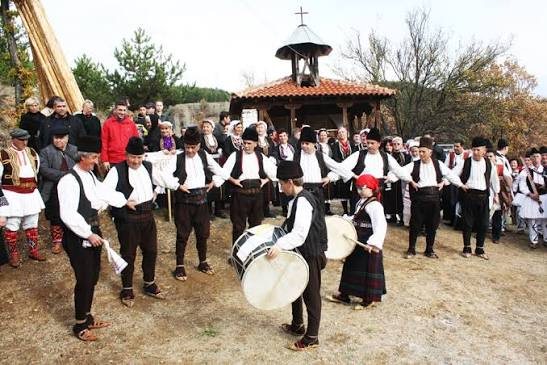
The dance is performed by male dancers in a semicircle. They hold each other's belts with crossed hands, which helps maintain stability as the movements become faster.
It begins with slower walking movements, then develops into quicker steps and forceful stamping. Drums, a fiddle, and sometimes tambura or bagpipes accompany the dance.
UNESCO's description also explains how knowledge is transmitted. Newer and younger participants begin at the end of the line and move closer to the front as their skill grows.
This detail matters because heritage is not only the movement itself. It is the method by which a community teaches responsibility, position, and belonging.
Kopachkata should therefore be presented with its exact local origin. It is part of Macedonian heritage, but it belongs first to the community that has preserved it.
Weddings turn music into a timeline
At many Macedonian weddings, music marks different stages of the day.
Songs and instrumental pieces accompany arrivals, family rituals, the gathering of guests, the entrance of the couple, dancing, and moments of heightened emotion.
Traditional music may sit beside pop, folk, rock, electronic music, international hits, and songs chosen for one family or generation.
This mixture is important. A Macedonian wedding is not a museum presentation of tradition.
The playlist changes because the people in the room carry different memories. Older relatives respond to one song, younger guests to another, and some songs unite the entire space.
The oro often becomes the point where these generations meet physically.
People who would not choose the same music in daily life can still hold the same line.
Songs carry language across distance
For Macedonians living abroad, music often protects more than memory.
It protects pronunciation, expressions, humour, regional accents, and emotional meanings that do not translate easily.
A song heard in Slovenia can bring Macedonia into the room without any decoration or explanation. People begin singing before they think about the words.
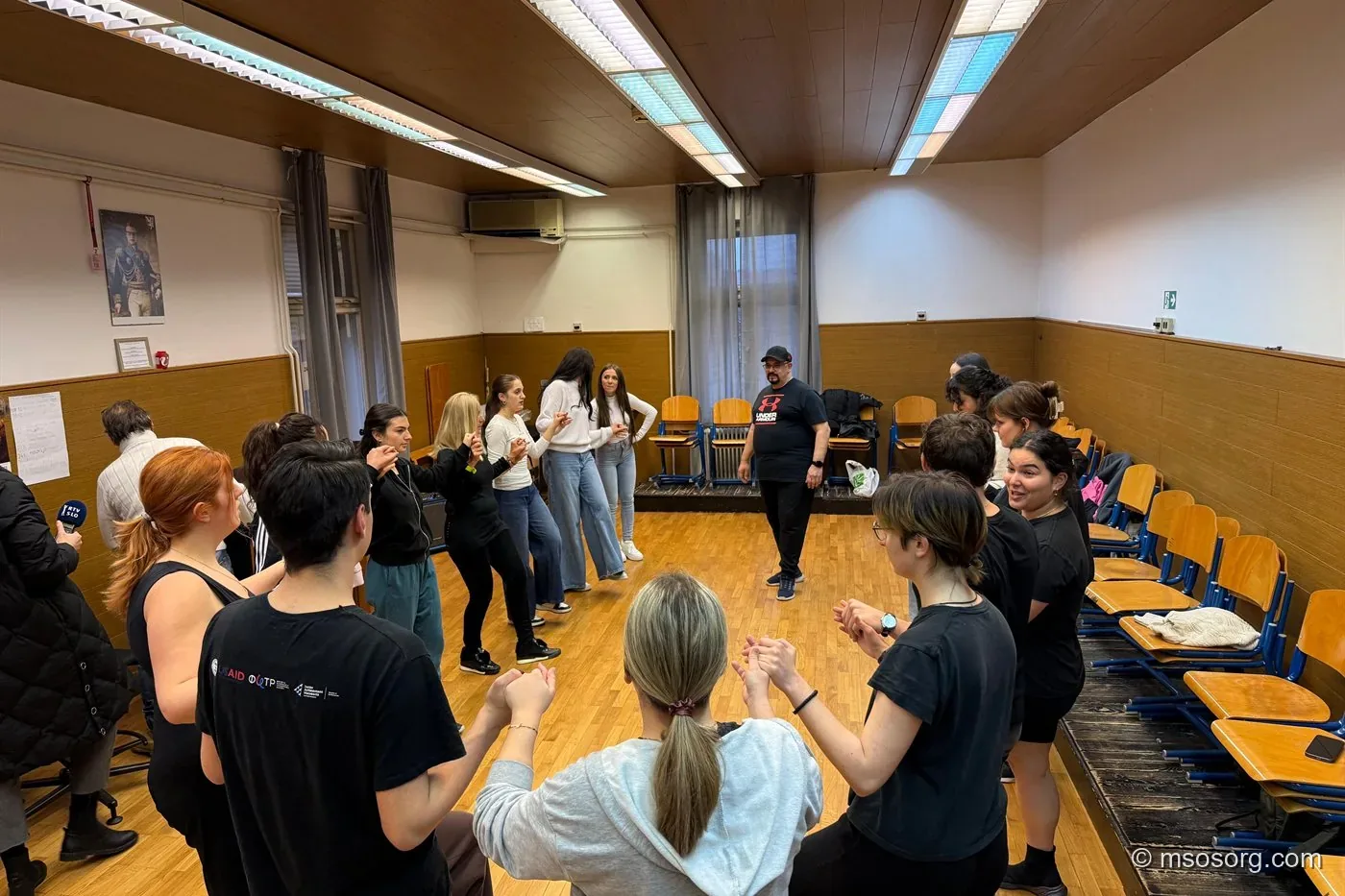
MSOS events use music for exactly this reason. It creates familiarity quickly, especially among students who come from different cities and may not know one another yet.
The same song can also become a bridge toward Slovenian and international friends. Explaining the rhythm, translating one verse, or inviting someone into an easy oro makes culture participatory rather than distant.
Music works best as an invitation.
Tradition continues because it changes
Traditional culture does not survive by remaining untouched.
Musicians rearrange old songs. Young dancers learn through folklore groups and then bring the steps into contemporary celebrations. Instruments appear beside electronic production. Archival recordings are rediscovered online. Regional styles meet in cities and among diaspora communities.
Some people prefer older forms. Others connect through modern interpretations.
Both relationships can be sincere.
The important question is whether the source is respected. A local dance should keep its name and origin. A traditional song should not become anonymous simply because it is widely known. Communities and performers deserve recognition.
Change becomes continuity when people know what they are carrying forward.
The line always has room for another person
The strongest image of Macedonian dance is not one perfect dancer.
It is the moment when the line grows.
A relative joins, then a friend, then someone who does not know the steps but is encouraged to try. The movement adjusts. The group makes space.
That is why music and dance remain central to belonging. They do not only represent identity. They create it in real time.
The rhythm begins with musicians, but the celebration becomes complete when everyone else responds.